Quantum Threat Hits Bitcoin's Clock
Solana Stablecoins Break Stablecoin Records | Aster Cuts Token Emissions by 97%


Marco Manoppo & Karon Pangestu
April 01, 2026

📢Sponsor | 💡Telegram | 📰Past Editions
Good Morning.
Google's quantum research team just handed the crypto industry its most uncomfortable wake-up call yet: a more efficient method for breaking the cryptography that secures Bitcoin and Ethereum, a shrinking timeline to "Q-day," and a stark reminder that decentralized networks can't patch vulnerabilities the way centralized systems can.
Check out our latest podcast episode!
In Today's Email:
What Matters: Quantum Threat Hits Bitcoin's Clock 👀
Case Study: Solana Stablecoins Break It’s Stablecoin Records 📈
Governance & Features: Aster Cuts Token Emissions by 97% ✂️
You read and share. We listen and improve. Send us feedback at [email protected].
Narratives: Post quantum infra
For daily market updates and airdrop alphas, check out our telegram!

WHAT MATTERS
Quantum Threat Hits Bitcoin's Clock
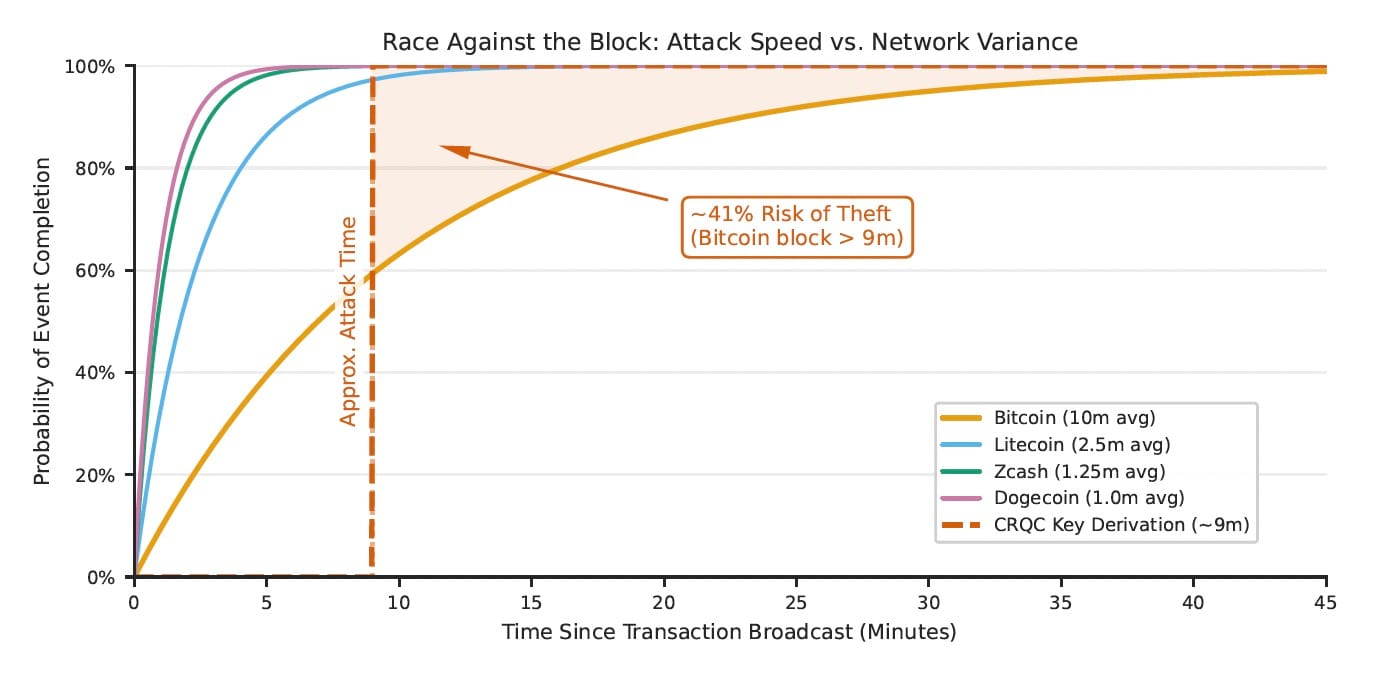
State of play: Google's latest quantum research is forcing the crypto industry to reckon with a timeline that's shrinking faster than expected, with some experts warning that Bitcoin's core cryptography could be crackable before it can coordinate a defense.
Google published a more efficient Shor's algorithm implementation that could reduce the resources needed to break elliptic curve cryptography.
Project Eleven warned a 9-minute key crack is faster than Bitcoin's 10-minute block time, meaning active transactions could be intercepted before confirmation.
Google flagged ~6.7M BTC as vulnerable, including 1.7M BTC in P2PK scripts with permanently exposed public keys, and withheld the quantum circuits from publication for the first time ever.
CZ argued upgrades to quantum-resistant algorithms are sufficient, though acknowledged decentralized coordination could trigger forks and new security risks.
Why it matters: Bitcoin can't patch overnight like centralized systems, and Google's paper compresses the timeline enough that the coordination problem is now the real risk.
Our take: With 6.7M BTC exposed and Google redacting circuit details, this is being treated as a live vulnerability. Networks without post-quantum plans are already behind.
For builders and investors: Post-quantum infrastructure is underfunded but moving fast. Project Eleven's $20M Series A signals early capital is flowing, and protocols with cryptographic agility built in will have a structural edge when upgrade pressure hits.

CASE STUDY
Solana Stablecoins Break It’s Stablecoin Records

$650B in stablecoin transactions in February, helping push aggregate monthly stablecoin volume to nearly $2T, a figure that now dwarfs gold futures trading on CME by nearly 9x.
Solana's stablecoin volume nearly tripled month-over-month in February, driven by the launch of Western Union's $USDPT and Jupiter's $JUPUSD.
Aggregate stablecoin transaction volume across all chains hit nearly $2T in February, with another surge expected in March amid the Iran War.
To contextualize the scale, CME gold futures volume sits at $208B per month, meaning stablecoins are now processing nearly 9x that figure.
Take a peek at our referral reward at the bottom of this issue. Share this newsletter and receive our list of 500 crypto VC individuals 👇

INSIGHTS

State of play: Asia is quietly becoming the epicenter of stablecoin adoption in real-world payments, with B2B volume and card spend both posting explosive year-over-year growth led by Singapore, Hong Kong, and Japan.
B2B stablecoin volume hit $226B, representing ~60% of total volume and up 733% YoY, as SMEs shift to stablecoins for faster, cheaper cross-border payments.
Card spend via stablecoins reached $4.5B, up 673% YoY, signaling growing consumer-layer adoption alongside the B2B surge.
Singapore, Hong Kong, and Japan collectively drive ~60% of global stablecoin volume, cementing Asia as the dominant region for real-world stablecoin usage.

FEATURES & GOVERNANCE UPDATE
Aster Cuts Token Emissions by 97%

Aster is overhauling its tokenomics by replacing a linear unlock schedule with a staking-only emission model, slashing monthly token releases from 78.4M to roughly 2.25M ASTER.
Monthly ASTER emissions drop 97%, from 78.4M tokens to 1.8M to 2.25M per month, released exclusively as staking rewards at 450K per epoch.
Combined with an existing buyback program allocating up to 80% of daily platform fees to token purchases, the update positions ASTER as a potentially deflationary asset.
Over 80% of the 8B total supply was allocated to the community, with the dev team receiving just 5%, and the Foundation's 7% remaining locked until governance approval.
Other notable feature updates:
GMX launched two upgrades.
Silo Finance launched Silo V3.
PistachioFi launched Pistachio v2.
Aave DAO approved the ARFC proposal.
Balancer restructures after November 2025 V2 exploit.
Whop integrated DeFi yield through Veda vault infrastructure.
Lido DAO has approved a $5M treasury allocation into its Earn vaults.

QUICK BITES
TD Cowen 'increasingly pessimistic' on crypto bill.
Fed's Barr encouraging strong stablecoin oversight.
Crypto awareness tops 80% among young people in UK.
New Hampshire authority to issue $100M bitcoin-backed bond.
Russia moves to narrow crypto trading to regulated intermediaries.
Benchmark calls Securitize a 'picks and shovels' play for tokenization.
A16z leads $10M round in startup developing stablecoins' missing layer.
Wall Street moves benchmarks onchain as S&P tokenizes Treasurys index.
Google’s quantum breakthrough sparks fresh debate over BTC’s security.
Dubai's VARA imposes margin, governance, and disclosure rules on crypto.
NOTEWORTHY READS & MEME

If you enjoy reading this issue, please consider subscribing. It takes 1 minute of your time, but it would mean the world to us 🙇
Disclaimer: All the information presented in this publication and its affiliates is strictly for educational purposes only. It should not be construed or taken as financial, legal, investment, or any other form of advice.