Launchy Regulatory Roundup #79 - SEC and CFTC Join Forces to Shape Crypto Regulation
IRS Crypto Reporting Rules for 2025 Tax Season


Marco Manoppo & Muhammad Reynaldi Ariananda Arkiang
March 15, 2026

📢 Sponsor | 💡 Telegram | 📰 Past Editions
Good Morning.
Welcome to our 79th edition of the regulatory roundup. If you know anybody who would benefit from this content, please help us spread the word!
In Today's Edition:
Headline: SEC and CFTC Join Forces to Shape Crypto Regulation 👀
Global Legal Roundup
Case Study: IRS Crypto Reporting Rules for 2025 Tax Season 🔎
You read and share. We listen and improve. Send us feedback at [email protected].
For daily market updates and airdrop alphas, check out our telegram!

HEADLINE
SEC and CFTC Join Forces to Shape Crypto Regulation
IMG: CoinGeek
State of play: The SEC and CFTC have signed an MOU to collaborate on crypto policy and digital asset innovation, aiming to reduce regulatory friction that has historically pushed market participants to other jurisdictions.
The SEC & CFTC signed an MOU to coordinate on lawful innovation, market integrity, and investor protection.
SEC Chairman criticized decades of regulatory turf wars and duplicative registrations that stifled innovation and drove market participants overseas.
A key priority of the agreement is developing a federal regulatory framework specifically designed for crypto assets and emerging technologies.
The two agencies committed to removing obstacles to the lawful introduction of crypto asset products, signaling a more pro-innovation approach.
While MOUs are non-binding, the agreement is seen as a positive signal for digital asset advocates, though significant regulatory work remains.
What’s Next: Both agencies will work toward aligning rules and removing barriers to new digital asset product launches under a unified federal framework.
Why it Matters: A coordinated approach between the two most powerful US financial regulators could bring long-awaited clarity, reducing compliance costs and making the US more competitive in digital asset innovation.
Our Take: While promising, non-binding agreements rarely guarantee action. The real test is whether both agencies can deliver concrete regulation beyond political posturing.
GLOBAL LEGAL ROUNDUP
America:
🇺🇲 SEC working on 'narrower' exemption for tokenized securities.
🇺🇲 Senate leader says Clarity Act unlikely to advance before April.
🇺🇲 US DOJ probes whether Iran used Binance to evade sanctions.
🇺🇲 US Senate votes to include CBDC ban in bipartisan housing bill.
🇺🇲 US sanctions DPRK IT facilitators over $800M crypto transactions.
🇺🇲 Binance sues WSJ over February article on Iran-linked crypto flows.
🇺🇲 Democrats push to ban prediction markets tied to war and fatalities.
🇺🇲 SEC dismisses civil fraud case against BitClout founder Nader Al-Naji.
🇺🇲 CFTC to set ‘rules of the road’ for prediction markets, Chair Selig says.
🇺🇲 FDIC chair says no deposit insurance for stablecoins under GENIUS Act.
🇺🇲 Trump's crypto advisor says stablecoins will drive Bank deposits in US.
🇺🇲 Federal judge dismisses Binance terrorism financing lawsuit in Alabama.
🇺🇲 Custodia's fight for a Fed master account ends in 7-3 appeals court loss.
🇺🇲 Crypto-backed PAC spends $8.6M in Illinois races ahead of US midterms.
Europe:
Middle East & Africa:
🇬🇭 Ghana greenlights 11 crypto companies for regulatory sandbox.
APAC:
CASE STUDY
IRS Crypto Reporting Rules for 2025 Tax Season
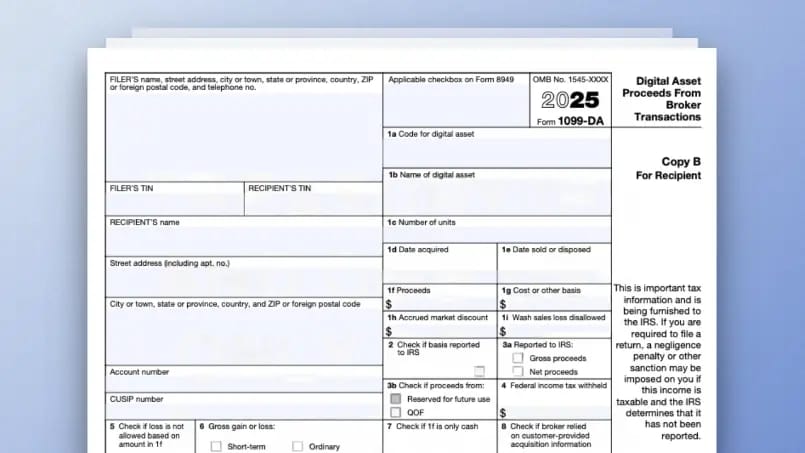
State of play: The IRS's new 1099-DA system requires crypto brokers to report gross proceeds from 2025 transactions, but leaves taxpayers responsible for tracking their own cost basis, creating confusion for active traders.
The new 1099-DA form requires crypto brokers to report gross proceeds, but cost basis data will not be required until the 2026 tax year.
Taxpayers must independently track what they originally paid for their crypto to accurately report gains or losses to the IRS.
DeFi traders and those transacting across multiple wallets face the greatest challenges, as manual reconciliation is described as "virtually impossible."
Discrepancies between 1099-DA forms and tax returns may trigger automated IRS letters, though full-scale audits are unlikely in the first year.
Starting in 2026, brokers will report both proceeds and cost basis for covered assets, making future reporting more straightforward for single-platform investors.
Our Take: The IRS phased rollout is practical, but the burden on individual taxpayers is disproportionate, making crypto tax software a necessity rather than an option for retail investors.
Take a peek at our referral reward at the bottom of this issue. Share this newsletter and receive our comprehensive database of crypto regulations around the world👇

If you enjoy reading this issue, please consider subscribing. It takes 1 minute of your time but it would mean the world to us 🙇
Disclaimer: All the information presented in this publication and its affiliates is strictly for educational purposes only. It should not be construed or taken as financial, legal, investment, or any other form of advice.