Launchy Regulatory Roundup #70 - US Crypto Market Structure Bill Likely Pushed to 2027
Europe’s DAC8 Crypto Tax Rules Spark Privacy Backlash


Marco Manoppo & Muhammad Reynaldi Ariananda Arkiang
January 11, 2026

📢 Sponsor | 💡 Telegram | 📰 Past Editions
Good Morning.
Welcome to our 70th edition of the regulatory roundup. If you know anybody who would benefit from this content, please help us spread the word!
In Today's Edition:
Headline: US Crypto Market Structure Bill Likely Pushed to 2027 👀
Global Legal Roundup
Case Study: Europe’s DAC8 Crypto Tax Rules Spark Privacy Backlash 🔎
You read and share. We listen and improve. Send us feedback at [email protected].
For daily market updates and airdrop alphas, check out our telegram!

HEADLINE
US Crypto Market Structure Bill Likely Pushed to 2027

State of play: A US digital asset market structure bill may not pass until 2027 due to political uncertainty around the 2026 midterm elections, according to a report from TD Cowen.
The legislation is facing hesitation from Senate Democrats ahead of the November elections.
TD Cowen suggests Democrats may delay or withhold support to avoid potential conflicts of interest and election risk.
As a result, final implementation of the bill could be pushed back to 2029.
A key point of contention is concern over potential conflicts tied to Donald Trump and his family, including links to crypto ventures such as World Liberty Financial, a mining firm, and the Official Trump memecoin.
A bipartisan draft already includes safeguards aimed at preventing senior government officials from holding or directly engaging in crypto assets.
Despite the delays, Senate Banking and Agriculture Committees are expected to begin markups as early as mid January.
What’s Next: If passed, the bill would shift primary oversight of digital assets toward the CFTC and reduce the role of the SEC, reshaping the US crypto regulatory landscape over the long term.
Why it Matters: Pushing the bill to 2027 keeps US crypto in regulatory limbo for longer. That uncertainty makes it harder for companies and institutions to build, invest, and launch products in the US, while enforcement remains the main rulebook.
Our Take: This delay is more about politics than crypto. Lawmakers agree on the direction, but election timing and optics are slowing things down.
GLOBAL LEGAL ROUNDUP
America:
🇺🇲 Senate crypto bill nears 'do-or-die' moment.
🇺🇲 FINRA taps Rostin Behnam and Dan Gallagher for its board.
🇺🇲 Trump says he has no plans to pardon Sam Bankman-Fried.
🇺🇲 Community banks sound alarm on YBS loophole in GENIUS.
🇺🇲 Polymarket faces first state-level cease-and-desist from Tennessee.
🇺🇲 CFTC issues no-action relief, clearing Bitnomial to offer event contracts.
🇺🇲 SEC's Caroline Crenshaw departs agency, leaving all-Republican panel.
🇺🇲 Florida becomes latest state to pursue BTC reserve ahead of 2026 session.
🇺🇲 Democrats back bill to ban elected officials from political prediction market.
🇨🇴 Colombia's tax authority mandates crypto exchanges to submit user data.
Europe:
🇬🇧 UK FCA signals September 2026 opening for crypto licensing gateway.
APAC:
🇨🇳 China’s financial associations reclassify RWAs as ‘risky.’
🇰🇷 South Korea considers pre-emptive crypto account freezes.
🇰🇷 South Korea’s top court rules exchange-held Bitcoin can be seized.
🇯🇵 Japan's finance ministerbacks crypto integration across stock exchanges.
CASE STUDY
Europe’s DAC8 Crypto Tax Rules Spark Privacy Backlash
IMG: Smart Options
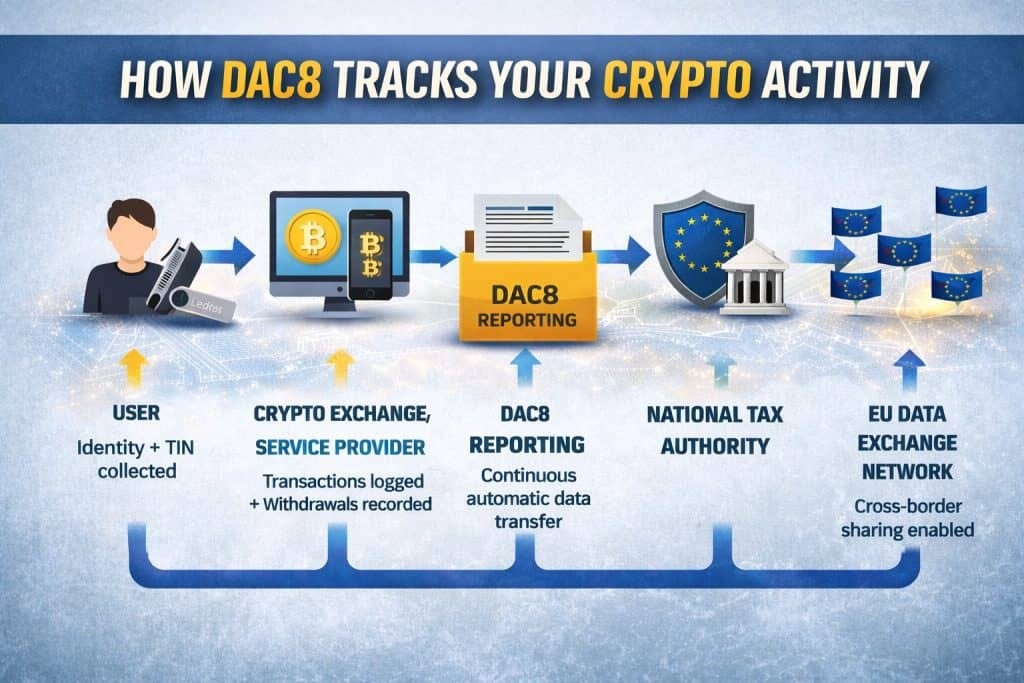
State of play: Europe’s DAC8 crypto tax reporting regime officially took effect on January 1, 2026, triggering a sharp debate within the crypto community over privacy and surveillance.
The rules require centralized crypto platforms to collect tax IDs, verify users, and report tx data annually to EU tax authorities, which then shared across member states.
Critics argue the directive marks a major erosion of privacy and increases data security risks, especially as DAC8 aligns with the OECD’s Crypto-Asset Reporting Framework and enables international information sharing across 40+ participating countries.
Some warn this could expose users to broad data “dragnets,” particularly in jurisdictions with weaker human rights protections.
The rules do not cover DEXs, peer-to-peer activity, or self-custody wallets, and they do not enable real-time monitoring of onchain transactions.
EU officials frame the measure as a tax compliance tool aimed at closing cross-border reporting gaps, with the first data exchanges scheduled for 2027.
Our Take: This reinforces a clear split, compliant exchanges move closer to TradFi, while privacy focused users lean more toward self custody and decentralized tools.
Take a peek at our referral reward at the bottom of this issue. Share this newsletter and receive our comprehensive database of crypto regulations around the world👇

NOTEWORTHY READS & MEME
If you enjoy reading this issue, please consider subscribing. It takes 1 minute of your time but it would mean the world to us 🙇
Disclaimer: All the information presented in this publication and its affiliates is strictly for educational purposes only. It should not be construed or taken as financial, legal, investment, or any other form of advice.